
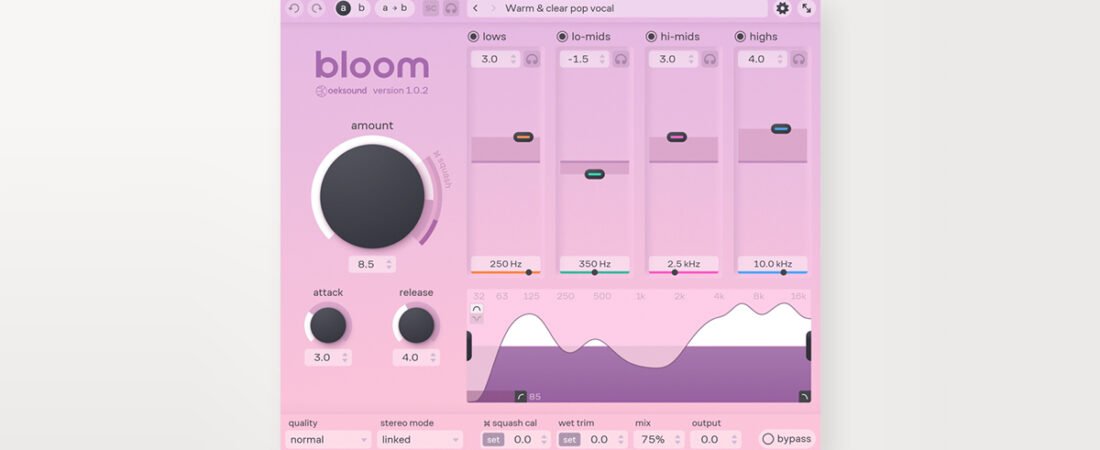
Following the industry-defining success of their dynamic resonance suppressor soothe2 and transient processor spiff, Finnish DSP innovator oeksound launched bloom. Positioned not as a standard equalizer, but as an “Adaptive Tone Shaper”, the plugin has rapidly become an indispensable secret weapon in modern mixing and mastering chains.
Unlike conventional equalizers that force fixed boost and cut curves across a track regardless of incoming musical dynamics, Bloom continuously listens, evaluates, and dynamically redistributes tonal energy in real time.
The Science of Adaptive Tone Shaping
Traditional parametric EQs boost or attenuate frequency bands statically. If you boost 3 dB at 8 kHz on a vocal, that boost is applied identically during quiet intimate whispers and loud belt passagesu2014frequently causing harsh sibilance. Dynamic EQs help by gating boosts behind thresholds, but they still operate on predetermined frequency points.
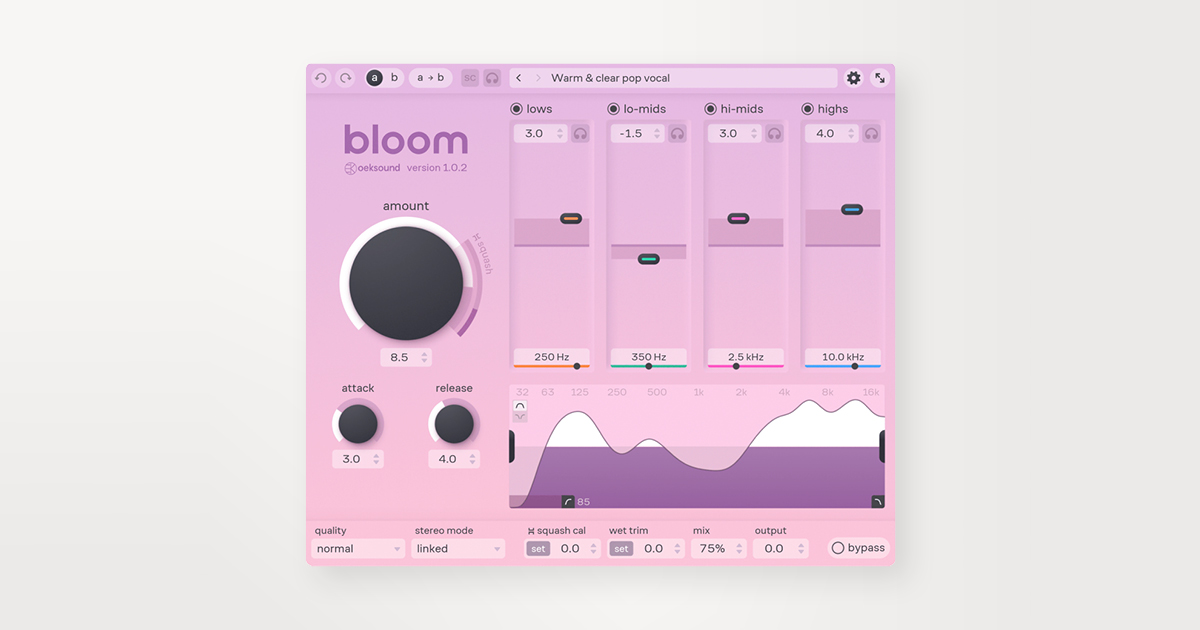
Bloom takes a radically different path. It continuously monitors the spectral distribution of the incoming audio and applies micro-corrections across hundreds of internal frequency points to guide the audio toward an optimal target balance:
- Four Tonal Balance Sliders (Low, Low-Mid, High-Mid, High): These sliders do not apply simple filter curves; they inform the algorithmic engine of your desired tonal disposition. Raising the High slider intelligently injects warmth, air, and sheen by lifting frequencies where they are absent, rather than indiscriminately amplifying harsh resonance spikes.
- Squash Mode (Frequency-Dependent Forward Compression): One of Bloom’s most celebrated features. Squash applies dynamic leveling that tames uneven performancesu2014such as a dynamic bassline with resonant hot notes or an acoustic guitar tracked in an imperfect roomu2014without inducing the audible pumping associated with traditional multiband compression.
- Precision Attack and Release Controls: Adjust whether the tone shaping acts aggressively on initial transients (ideal for brightening snare drums and percussive plucks) or smoothly over sustained pads, synth leads, and whole-mix busses.
- Mid/Side & Low-Latency Architecture: Fully equipped with Mid/Side mode for expanding stereo width without degrading center mono punch, alongside a true low-latency tracking mode suitable for recording monitoring.
“Bloom does not feel like an EQ; it feels like hearing the ideal version of your audio file being uncovered beneath accumulated mud and harshness.”
Sponsored
Practical Mixing Applications
In real-world studio testing, Bloom delivers extraordinary results across several difficult scenarios:
- Drum Bus & Overheads: Slightly pulling down the Low-Mid slider while gently elevating High instantly clears boxy cardboard resonances and brings cymbal brass to life.
- Lead Vocals: Using moderate Amount with gentle Squash smoothens proximity effect variations when vocalists shift distance from the capsule.
- Mix Bus & Stem Mastering: Used sparingly (between 10% and 25% Amount), Bloom acts like an elite analog console summer, knitting distinct instruments together into a cohesive, radio-ready frequency envelope.
Official Sources & References
- oeksound – Official bloom Product Page and Manual
- Mix Magazine – oeksound bloom Adaptive Tone Shaper Plug-in Review
- Sound On Sound – Detailed Technical Review of oeksound bloom